
The dumbbell floor press is the chest exercise I program more than any other, and it is the reason nobody in our membership needs a bench (no one needs a bench, but I do love a bench because they’re so versatile). You lie on the floor, press two dumbbells from your chest to straight arms, and the floor does the job a bench normally does, with one useful difference: it stops your elbows at the exact point where most shoulders start to complain (and as we get older we know that shoulder pain all too well). Below is how I coach it, what it works, how it stacks up against a bench press, and a four-week progression you can run on a mat in your living room.
Get the 4-week tracker for this guide, free.
Print it, stick it on the fridge, tick off each session. Plus every new guide by email, one a week at most.
By subscribing you agree to receive emails from Bounce Forward Co. Unsubscribe any time.
In this guide
What is a dumbbell floor press?
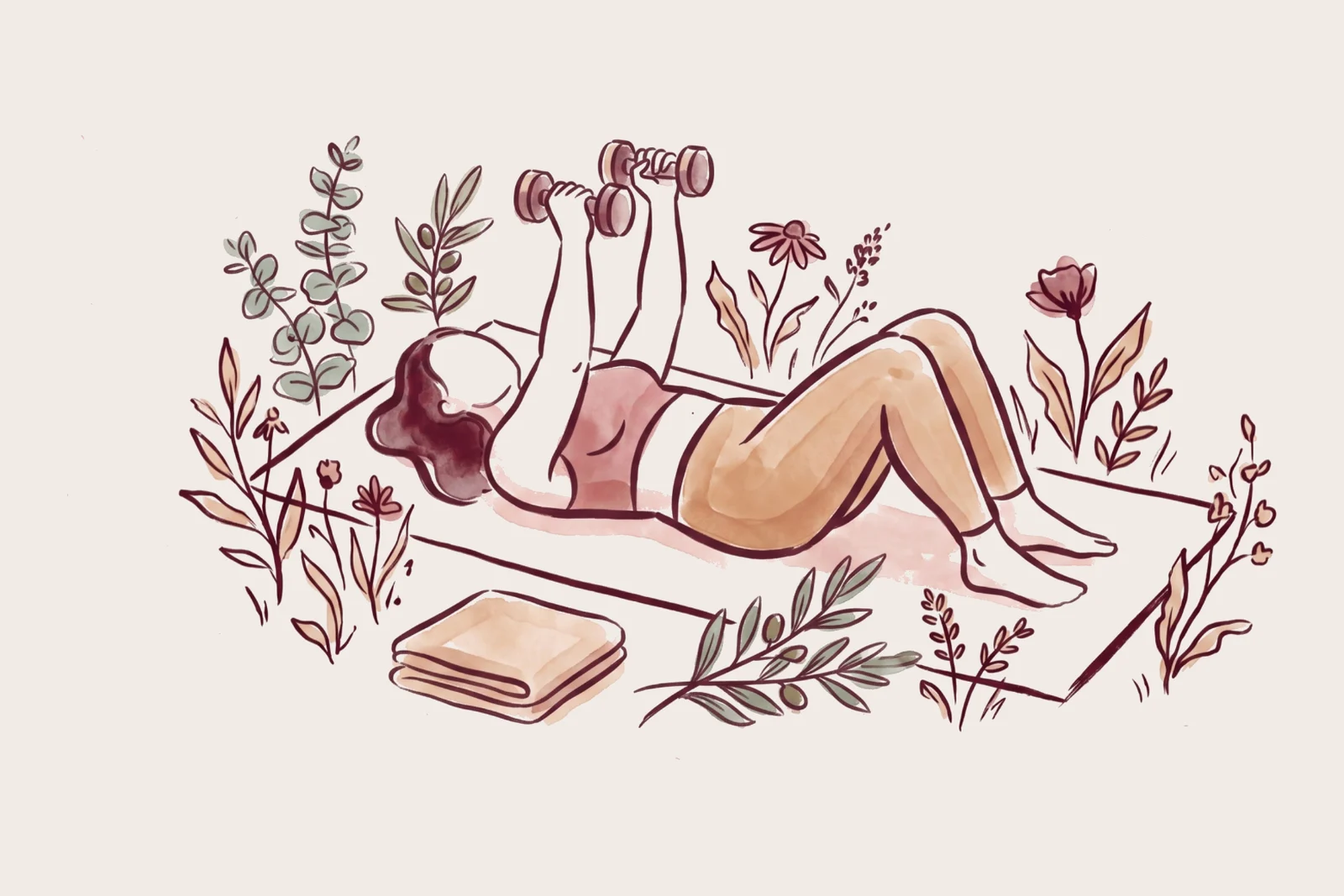
A dumbbell floor press is a horizontal pressing exercise performed lying on your back on the floor, with your knees bent and a dumbbell in each hand. You lower the weights until the backs of your upper arms touch the floor, pause, and press back up. Because the floor blocks your elbows from dropping below your torso, the range of motion is shorter than a bench press, roughly the top two-thirds of the movement. That shorter range is the whole point of the exercise, not a limitation of it.
What muscles does the dumbbell floor press work?
The floor press works your chest (pectoralis major), the front of your shoulders (anterior deltoid), and your triceps, with a heavier share going to the triceps than a full bench press. It also forces your core and glutes to hold your torso still while the weights move. BarBend’s comparison puts it plainly: the reduced range minimizes chest stretch and places greater loading on the elbow extensors. In practice that means the floor press builds pressing strength and arm strength at the same time, which is exactly what a mom wants for lifting a car seat with your infant in it while holding your toddler.
- Chest: the main mover through the middle of the press.
- Triceps: finish the press; the shorter range makes them work harder than on a bench.
- Front shoulders: assist the chest, but with less strain at the bottom because the elbows cannot drop past the torso.
- Core and glutes: keep your ribs down and your back flat against the floor.
How do I do a dumbbell floor press with good form?
Set up on the floor with the dumbbells resting on your thighs, roll back so the weights come with you, and press from a position where your upper arms sit at about 45 degrees to your body. Here is the full sequence I coach:
- Setup Sit on a mat with your knees bent, dumbbells standing on your thighs. Lie back and use your legs to kick the weights up over your chest, one at a time. This is safer than lifting them from the floor beside you.
- Feet Flat on the floor, knees bent, so you can push lightly through your heels. Straight legs are fine too if that feels more stable (shoes are optional, totally a preference).
- Back Ribs down, lower back close to the floor, a small natural arch is fine. Do not lift your bum or arch hard; that turns the exercise into something else.
- Arms Palms facing forward or slightly turned in. Upper arms at about 45 degrees from your torso, not flared straight out to the sides.
- Lower Bend your elbows and lower under control until the backs of your upper arms rest on the floor. Let the weight settle for a second. Do not bounce.
- Press Push the dumbbells up and slightly together until your arms are straight over your chest. Exhale as you press. Squeeze your chest at the top without locking your elbows hard.
- Finish When the set is done, bring the weights to your chest, then to your thighs, and sit up. Do not drop them beside you.
Dumbbell floor press vs dumbbell bench press: which is better?
Neither is better in general. The floor press is better for home training, for anyone with cranky shoulders, and for building the lockout and triceps. The bench press is better for maximum chest stretch and for lifters chasing the biggest possible pressing numbers. Here is how they compare for the way most of our members train:
| Dumbbell floor press | Dumbbell bench press | |
|---|---|---|
| Equipment | Dumbbells and a floor | Dumbbells and a bench |
| Range of motion | Shorter; elbows stop at the floor | Full; elbows drop below the torso |
| Shoulder stress at the bottom | Lower | Higher |
| Chest emphasis | Moderate | Higher |
| Triceps emphasis | Higher | Moderate |
| Learning curve | Easy; the floor gives feedback | Moderate; bench setup and stability |
| Safe to fail | Yes; lower the weights to your chest and roll them to your thighs | Harder without a spotter |
| Best for | Home training, shoulder-friendly pressing, arm strength | Gym training, maximum chest development |
If you have a bench, use both. If you have a mat and two dumbbells, the floor press gives you most of what a bench does and none of the setup. That is why BUILD uses it from phase one.
What weight should I use for the dumbbell floor press?
I think this is the most common question that I get: what weight should I buy? And of course this differs from person to person. My best advice is to start with a weight you can press for 12 clean reps with two or three left in the tank, which for most women new to strength training is somewhere between 8 and 15 lb per hand. Move up when 12 reps feel easy on every set. The two dumbbell weights I tell new members to buy are 10 lb and 20 lb, and the floor press is one of the exercises that lets you grow into the heavier pair.
A 4-week dumbbell floor press progression
Do this twice a week with at least two days between sessions. Rest 60 to 90 seconds between sets. Weeks 1 and 2 teach the movement; weeks 3 and 4 build strength.
- Week 1 3 sets of 12 reps, light weight, 2-second pause with your arms on the floor at the bottom. Learn the setup and the pause.
- Week 2 3 sets of 10 reps, add a little weight. Keep the pause. Add a single-arm set of 8 per side at the end, light, to feel your core resist the twist.
- Week 3 4 sets of 8 reps, heavier. Pause only for a second. Finish with 1 set of 12 at your week-1 weight.
- Week 4 4 sets of 6 reps, heaviest weight you can press with clean form, then 2 sets of 12 at a lighter weight. Test: if 6 felt strong, this is your new working weight for the next block.
Pair the floor press with a dumbbell row on the same day so your back does as much work as your chest. Every upper body day inside BUILD is built that way.
Give your legs the same treatment on the other days of the week. Our guide to sumo deadlifts at home covers the first heavy lower body lift I teach, and it runs on the same two dumbbells you already have out.
What are the most common dumbbell floor press mistakes?
The mistakes I correct most often are flared elbows, bouncing off the floor, and arching the back to get the weight up. Fixes:
- Elbows flared to 90 degrees. Tuck them to about 45 degrees. This protects the shoulder and lets your chest and triceps share the load.
- Bouncing. Let your arms settle on the floor for a full beat before pressing. The pause is what builds strength from a dead stop.
- Arching or lifting the hips. Keep your ribs down and glutes lightly engaged. If you need to arch to finish a rep, the weight is too heavy.
- Dumbbells drifting apart at the top. Press slightly inward so the weights finish over your chest, not over your shoulders.
- Holding your breath. Exhale on the press. This matters double if you are postpartum, because breath-holding drives pressure down onto the pelvic floor.
Is the dumbbell floor press safe postpartum?
Yes, once you have been cleared to exercise and can lie on your back comfortably, which usually means after your six-week check. It is one of the first upper-body exercises we bring back after Restore Your Core, because it loads your arms and chest without asking anything risky of your core or pelvic floor. Start light, exhale on every press, and watch your belly for doming. C-section moms should be fully comfortable lying flat and rolling to their side before adding weight. If you want the full order of operations, our postpartum ab workout covers what to rebuild before you load.
Frequently asked questions
Can I do a floor press with one dumbbell?
Yes. A single-arm floor press is harder on your core than the two-arm version because your torso has to resist rotating toward the loaded side. Keep your free hand on your belly to feel it stay flat, and do the same reps on both sides.
Should my legs be bent or straight?
Either works. Bent knees with feet flat let you brace through your heels and keep your lower back closer to the floor. Straight legs take the legs out of it and make the press slightly harder. I start people with bent knees.
How is a dumbbell floor press different from a push-up?
Both work the chest, shoulders, and triceps. The floor press lets you choose the exact weight and is easier on wrists and core, so it is the one I use to build pressing strength. Push-ups need you to hold a plank through the whole movement, which makes them a core exercise as much as a chest exercise. Most of our members do both: floor press for strength, push-ups (from knees or an incline at first) for the plank work.
Sources
- BarBend’s comparisonbarbend.com
The content on the Bounce Forward Journal is for general information and education only. It is not medical advice, is not a substitute for professional diagnosis or treatment, and does not create a practitioner–patient relationship. It is written by a certified pre and postnatal fitness coach, not a physician or physiotherapist.
Talk to your doctor or another qualified health professional before beginning any exercise program, and get their clearance after pregnancy, childbirth, surgery, injury, or a diagnosis such as diastasis recti, pelvic organ prolapse, or pelvic pain. Stop exercising and seek medical attention if you experience pain, bleeding, dizziness, chest pain, shortness of breath, or anything that feels wrong. In an emergency, call 911. Never ignore professional medical advice or delay seeking it because of something you read here. Results vary from person to person, and you take part in any exercise at your own risk. Read the full medical disclaimer.