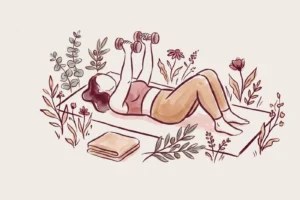
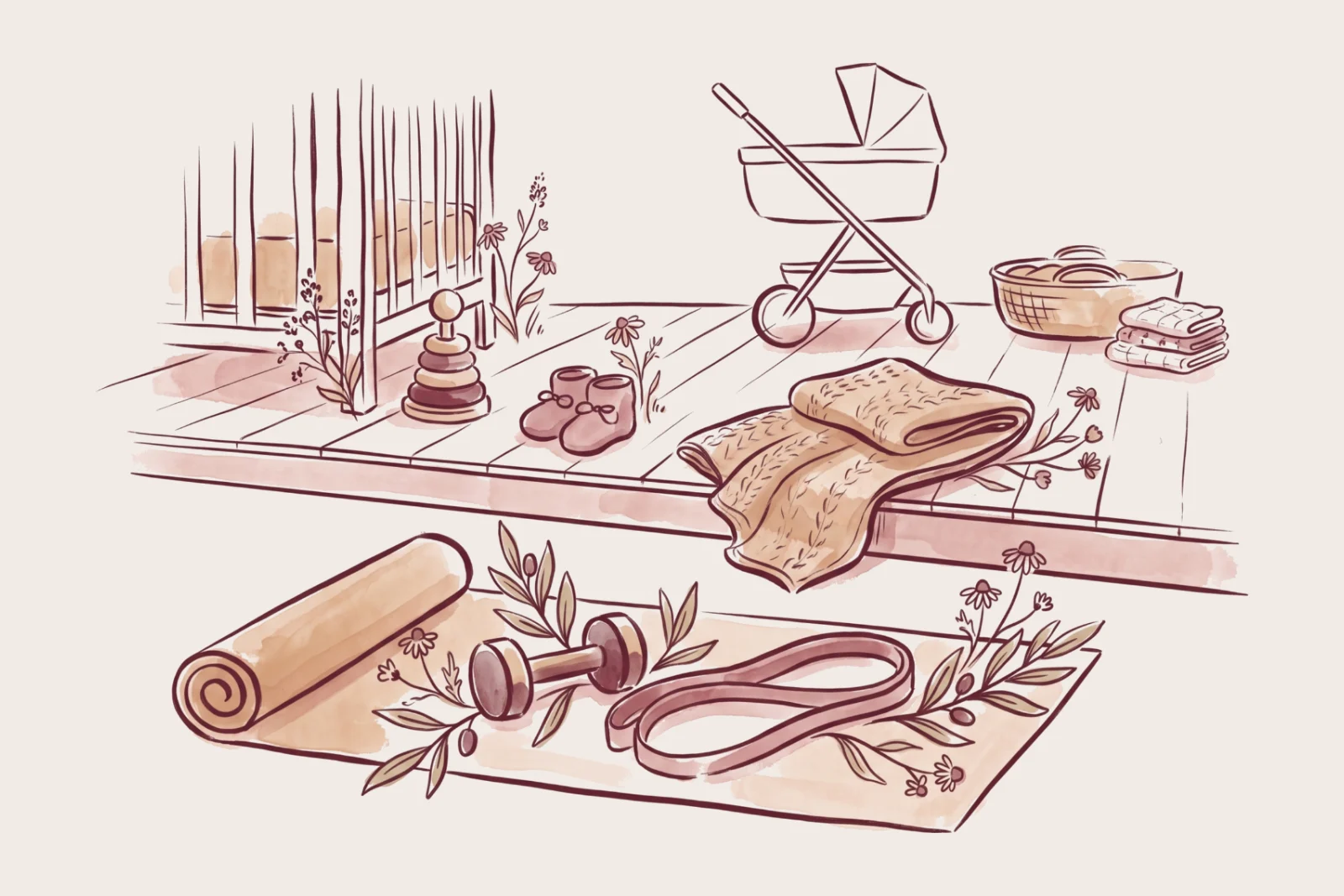

A postpartum ab workout should not look like the ab workout you did before pregnancy. Your abdominal wall stretched for nine months, your pelvic floor carried the load, and both need to be retrained before they can handle crunches or planks again. The four-week progression below is the one I coach inside Restore Your Core, our six-week postpartum program. It starts with breathing and ends with a dumbbell in your hand. Every session takes 10 to 15 minutes and needs nothing more than a floor, a band, and one dumbbell.
Get the 4-week tracker for this guide, free.
Print it, stick it on the fridge, tick off each session. Plus every new guide by email, one a week at most.
By subscribing you agree to receive emails from Bounce Forward Co. Unsubscribe any time.
One rule before anything else. Get cleared by your care provider first, usually at your six-week check, and later if you had a c-section or complications. Nothing here replaces that conversation.
In this guide
When can you start a postpartum ab workout?
This is the question I get most from new moms, and the honest answer is that it varies from birth to birth. Most women can start gentle breathing and pelvic floor work within days of an uncomplicated vaginal birth, and structured core exercise after their postpartum check-up. ACOG says it is usually safe to begin exercising a few days after giving birth, and that women who had a cesarean birth or complications should ask their provider first. Canada’s 2025 postpartum guideline recommends daily pelvic floor training and a gradual, symptom-based progression toward 120 minutes of moderate to vigorous activity per week. Gradual is the important word. Week 1 below is gentle enough for most women to start once bleeding has settled and they feel ready.
What does “doming” or “coning” mean, and why does it matter?
Doming (also called coning) is a ridge or bulge that pops up along the midline of your belly when you exert yourself. It means the pressure inside your abdomen is pushing outward through the gap between your ab muscles instead of being managed by your deep core. It is your stop signal for every exercise in this plan. If you see a dome, make the move easier, slow it down, or stop and breathe. Doming is closely tied to diastasis recti, which Cleveland Clinic says affects about 60% of women after childbirth. If you have not checked your gap yet, the one-minute self-check is in our diastasis recti exercises guide.
What is the 4-week postpartum ab workout plan?
The plan rebuilds your core from the inside out: breath first, then deep core, then hips and rotation, then load. Do the session four or five days a week. Each week builds on the last, so do not skip ahead even if Week 1 feels too easy.
| Week | Focus | Moves | Dose |
|---|---|---|---|
| 1 | Breathing and pelvic floor connection | 360 breathing, pelvic floor lift and release, supported breathing on your side | 10 minutes, 4 to 5 days. 3 sets of 8 to 10 breaths per move |
| 2 | Deep core | Pelvic tilts, heel slides, dead bug regression (one arm or one leg at a time) | 10 to 12 minutes. 2 to 3 sets of 8 to 10 per side |
| 3 | Hips and stability | Glute bridges, bird dog, side-lying leg lifts and clamshells | 12 to 15 minutes. 3 sets of 10 to 12 per side |
| 4 | Standing and loaded core | Band anti-rotation press (Pallof press), suitcase carry with one dumbbell, modified plank on knees or an incline | 15 minutes. 3 sets of 8 to 10 presses per side, 3 carries of 20 to 30 metres per side, 3 plank holds of 15 to 20 seconds |
Week 1: breathing and pelvic floor connection
Week 1 teaches your diaphragm, deep abdominals, and pelvic floor to work together again. Lie on your back with knees bent. Inhale and let your ribs, belly, and pelvic floor expand. Exhale slowly through pursed lips, feel your pelvic floor lift, and let your lower belly draw in gently. That is one rep. Do not squeeze hard (I know, it is boring; breathwork is exactly where my own postpartum training started, and it is still the part that matters most). A pelvic floor that only knows how to clench is as much of a problem as one that is weak, which is why Cleveland Clinic describes both relaxing and contracting as part of healthy pelvic floor function. Ten minutes a day is enough.
Week 2: deep core
Week 2 adds small limb movements while you hold the connection you built in Week 1. Pelvic tilts come first: exhale and flatten your low back into the floor, then release. Heel slides come next: exhale and slide one heel away along the floor, then inhale and bring it back. Finish with a dead bug regression. Start on your back with knees stacked over hips, and lower one arm overhead or one heel to the floor at a time. Only do both together if your belly stays flat. Watch your midline on every rep. Small as these moves look, they are the building blocks that get you back to lifting heavy.
Week 3: hips and stability
Week 3 brings in your glutes and the muscles that keep your pelvis still. Glute bridges load the back of your body while your core holds the front steady. Bird dog makes you reach an arm and the opposite leg away without letting your low back sag or your belly dome. Side-lying leg lifts and clamshells strengthen the hips without loading the midline at all (nobody loves a clamshell, but they work). Move slowly. Three seconds up and three seconds down is a good pace.
Week 4: standing and loaded core
Week 4 is where the ab workout starts to look like real training again. Anchor a band at chest height, hold it with both hands, and press it straight out in front of you while the band tries to twist you. That is the Pallof press, and it forces your core to resist rotation, which is most of what carrying a baby demands. A suitcase carry is exactly what it sounds like: hold one dumbbell at your side and walk tall without leaning. Finish with a modified plank on your knees or with hands on a bench. Fifteen seconds with a flat belly is worth more than a minute with a dome. If you have made it here with a flat midline, you have done the hard part.
Which ab exercises should you skip in the first 12 weeks?
Skip anything that spikes pressure through your midline before your deep core can handle it. Cleveland Clinic recommends avoiding crunches, sit-ups, planks, and push-ups in the early stage of diastasis recovery. For most women that early stage is roughly the first 12 weeks, and longer if the gap is wide or symptoms persist. Hold off on:
- Crunches, sit-ups, and bicycle crunches
- Full front planks and push-ups from the toes
- Double leg lifts and V-sits
- Heavy overhead pressing, which loads the abdominal wall before it is ready
- Any move that makes your belly dome, whatever it is called
None of these are banned forever, and you have your whole life to do crunches. They come back once you have passed the readiness checks below, and they show up again in the right order once you move into full strength training.
Upper body work comes back sooner than crunches do. The dumbbell floor press is usually the first press I bring back, because it loads your chest and arms while your back stays flat on the floor.
How do you know you are ready to move to the next week?
You are ready to progress when you can finish every set of the current week without doming, leaking, pain, or a sense of heaviness in your pelvis. If any of those show up, stay on the current week for another seven days. Two more tests help at the end of Week 4. First, you can hold your modified plank for 20 seconds with a flat midline and steady breathing. Second, you can carry a dumbbell that is about a quarter of your body weight for 30 metres per side without leaning or holding your breath. Pass both and you are ready for a full program. Inside Bounce Forward, that means finishing Restore Your Core and moving into BUILD 1, the first block of our progressive dumbbell and band strength program.
When should you see a pelvic floor physiotherapist?
See a pelvic floor physiotherapist if you have leaking, pelvic pain, pain with sex, a feeling of bulging or heaviness in your vagina, or a belly gap of three finger-widths or more that is not closing with consistent work. The NHS advises contacting your GP if the gap is still obvious eight weeks after the birth, since it can put you at risk of back problems. In Canada you can book pelvic floor physio directly without a doctor’s referral, and many extended health plans cover it (I booked mine right after my six-week check, before I started exercising). Pelvic Health Solutions keeps a searchable directory of trained Canadian practitioners. A physio assessment and a coached program work well together. The physio looks inside and tells you what your pelvic floor is doing. The program gives you the daily reps.
Frequently asked questions
Can I do this postpartum ab workout after a c-section?
Yes, once your provider has cleared you, which is often later than six weeks. Week 1 breathing is usually fine early on. Wait for clearance before Week 2, and let scar tenderness set the pace.
Will a postpartum ab workout flatten my stomach?
It will make your core stronger and can reduce a diastasis gap, which often changes how your belly looks. It will not reduce belly fat on its own. Overall strength training, walking, and time do more for that than any single ab exercise.
How long until I can do crunches again?
It depends on your gap and your symptoms, not the calendar. A study of first-time mothers found about 45% still had diastasis at six months and about 33% at twelve months, so some women need longer than others. When you can plank without doming and carry weight without leaking, crunches can be reintroduced a few reps at a time.
Can I do this if my baby is a year old?
Yes. The same order works whether you are six weeks or several years postpartum. Start at Week 1 anyway. Most women find they move through the early weeks faster than expected.
Sources
- ACOGacog.org
- 2025 postpartum guidelinecsepguidelines.ca
- Cleveland Clinicmy.clevelandclinic.org
- Cleveland Clinicmy.clevelandclinic.org
- NHSnhs.uk
- Pelvic Health Solutionspelvichealthsolutions.ca
- Study of first-time motherspubmed.ncbi.nlm.nih.gov
The content on the Bounce Forward Journal is for general information and education only. It is not medical advice, is not a substitute for professional diagnosis or treatment, and does not create a practitioner–patient relationship. It is written by a certified pre and postnatal fitness coach, not a physician or physiotherapist.
Talk to your doctor or another qualified health professional before beginning any exercise program, and get their clearance after pregnancy, childbirth, surgery, injury, or a diagnosis such as diastasis recti, pelvic organ prolapse, or pelvic pain. Stop exercising and seek medical attention if you experience pain, bleeding, dizziness, chest pain, shortness of breath, or anything that feels wrong. In an emergency, call 911. Never ignore professional medical advice or delay seeking it because of something you read here. Results vary from person to person, and you take part in any exercise at your own risk. Read the full medical disclaimer.